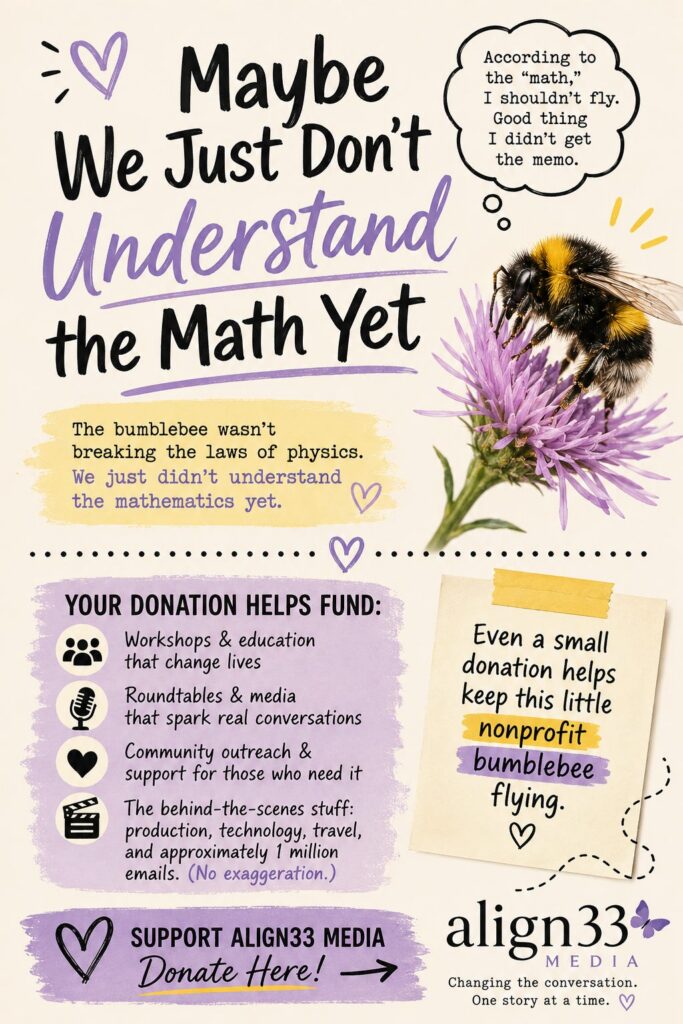
There’s an old saying that, according to the laws of physics, a bumblebee shouldn’t be able to fly. Technically, that isn’t true. Scientists eventually figured out that the problem wasn’t the bumblebee — it was the way people were trying to understand how it flew. Early calculations treated the bee too much like a tiny airplane. Its body seemed too heavy. Its wings seemed too small. The math didn’t add up. Except the bumblebee was flying. It wasn’t breaking the laws of physics. We simply didn’t understand the mathematics yet.
Morgan DiPrimo opens with that image because, for most of her life, she has felt a little like the bumblebee. She grew up with a learning disability — diagnosed with ADD, equipped with an IEP, a 504, occupational therapy, extra help, and what she describes as “the whole academic alphabet soup.” School was hard. She could study for six hours and get a 70 while someone else studied for twenty minutes and got a 95. When you’re a kid, she writes, you don’t understand that your brain processes information differently. You just look around the classroom and think: everyone else can do this. Why can’t I? And slowly, “I learn differently” becomes “I’m stupid.” That, she says, is a dangerous equation for a kid to start believing.
But put her somewhere creative — in front of people, given an idea to build, asked to improvise or connect dots or tell a story — and it was a different kid entirely. Maybe she was never bad at learning. Maybe people just didn’t understand the mathematics of how her brain learned.
That distinction matters, she argues, because when we don’t understand something, humans have a terrible habit of deciding the thing itself is broken instead of considering that maybe our model is incomplete. She connects this same pattern to eating disorders and recovery — the danger of assuming that what we don’t yet understand must be impossible.
Originally published on morgandiprimo.substack.com.